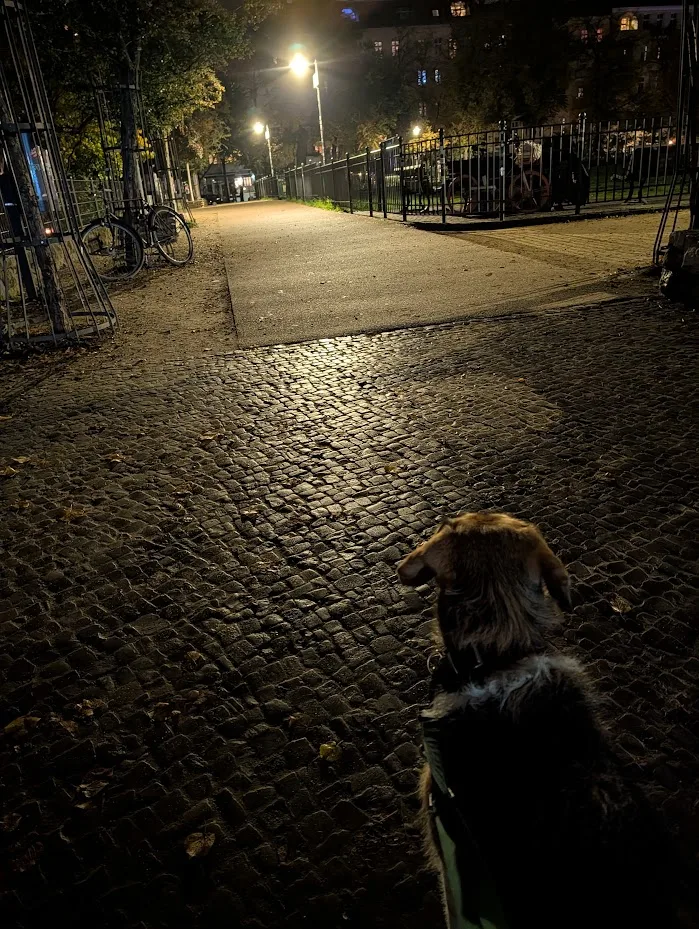
My AI system explains itself to me on dog walks

How do you remember and understand things? I find I need to hear them to truly “get it”. A page of documentation I read at my desk is gone by lunch, while the same idea explained out loud on a walk stays with me for weeks.
That became a problem once my agents started writing more about my setup than I do. It is hard to read full planning documents or long conclusions at the end of a complex building session. How does my personal AI operating system actually work? How does it fit into new and existing projects, and where are its weaknesses or missed opportunities? Where could I do better across meetings, agent interactions and system architecture?
Those questions made me build a weekly retro dashboard that reflects on my meetings, agent sessions and objectives, and on what moved in technology and the market. I rarely opened it. A few weeks ago that changed. My agents now turn the system and my week into podcast episodes, and I listen to them while walking the dog. The first weekly retro told me something about myself that no dashboard had shown me: I kept busy with actions so I could avoid taking decisions.
Comprehension debt
Talk to other people who build with agents and you hear the same thing: our systems improve faster than we can follow them. Many of us run setups that learn and fix themselves, and they end up running ahead of our picture of how it all fits together. I review the pieces as they ship, a diff here and a ticket there, but my grip on the whole starts to slip. And the whole, the architecture and the direction of the system, is exactly the part I want to steer.
Call it comprehension debt. If you build with agents, you probably carry some too. The obvious fix is to read more. It did not work for me: the reading competes with a screen full of other work, and loses.
So the debt has to be paid off somewhere without a screen. For me that place is the daily dog walk. There is nothing else to click, so a thirty-minute episode gets my full attention, and the dog does not mind when I stop to type a note into my phone.
How an episode gets made
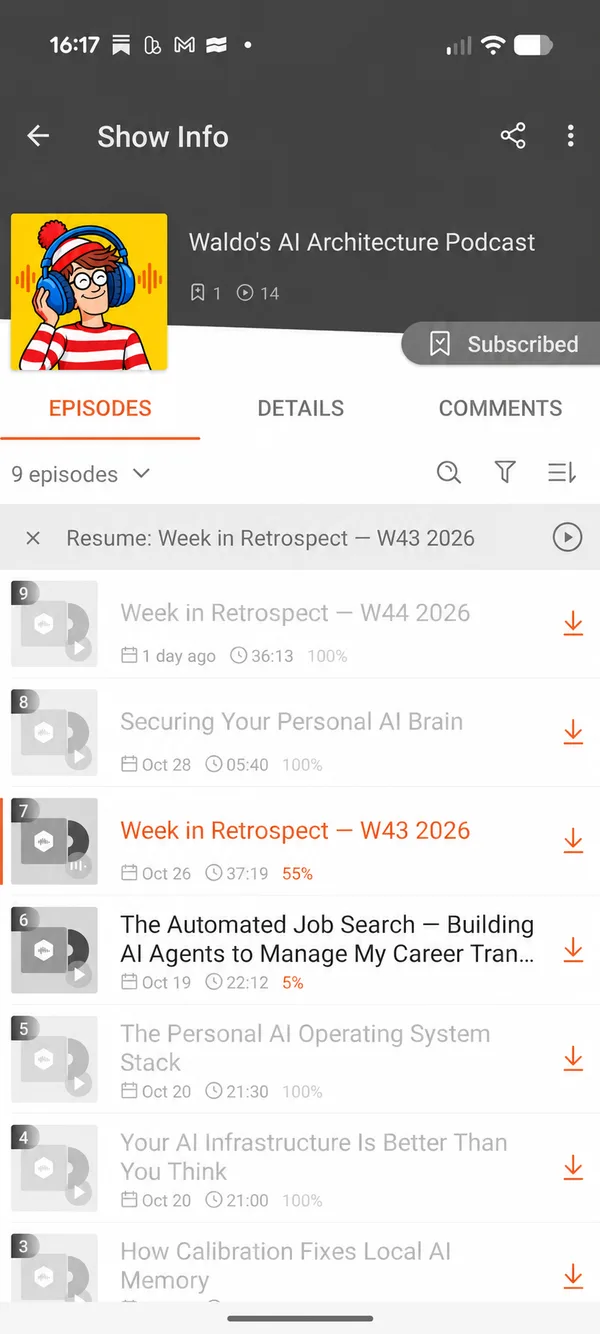
The setup sounds heavier than it is, and most of it runs on tools you may already use. I only listen. My chief-of-staff agent runs the rest:
- An agent writes the source document: an explanation of something I am working on, or a scheduled retro.
- It opens NotebookLM in Chrome, where the document becomes an audio file: two AI hosts talking through the material for about thirty minutes.
- When the audio is ready, it gets pushed to my server.
- My server publishes a private RSS feed behind a password.
- I listen in any podcast app, and new episodes show up as soon as they are published.
If you try this, the format matters more than you would expect. On day two an agent decided to save a step and generated an episode with the Mac’s built-in text-to-speech: eight minutes of one robotic voice reading a script. I deleted it right away, and “NotebookLM only” now sits in the setup docs, so no agent tries it again. The NotebookLM format holds up better than I expected: two hosts who interrupt each other, ask why and reach for analogies explain better than a perfect script read aloud.
The weekly retro as an episode
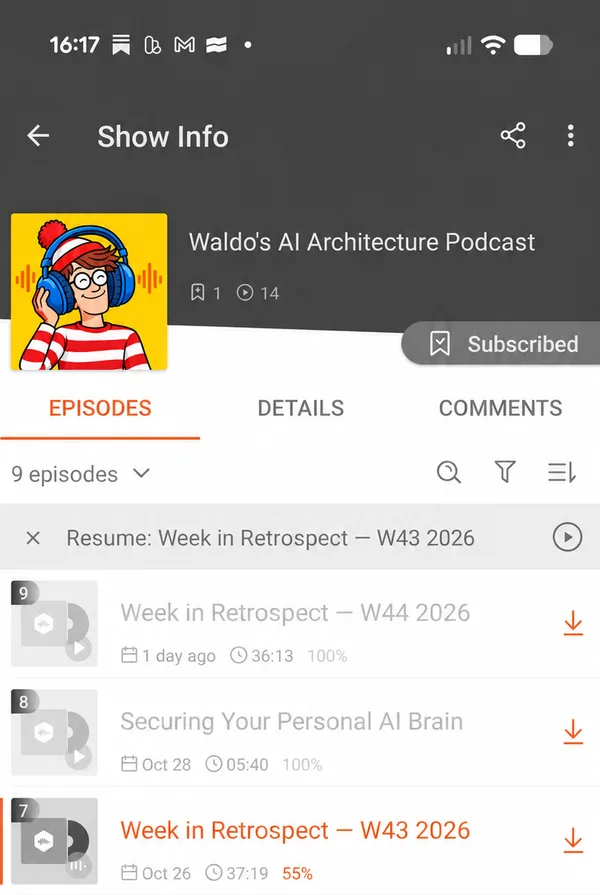
The episodes about my setup taught me how the system works. The retro episode taught me how I work, and that one landed harder.
Every Monday at 12:00 a scheduled job collects my past week: tickets closed per project, agent sessions, meetings, open loops and the commitments I made the week before. An agent turns that into a retro email and an episode script, and two NotebookLM hosts talk through my week while I walk the dog. The email I could skim. The episode I could not, and in week 43 it went straight for the weak spot.
What I overlooked
That week I had run my six-agent review council eleven times, on single tickets and posts. The hosts did not let it go:
“You aren’t actually looking for better output. You’re looking for a reason to delay. […] If you just said, I’m too scared to publish this, well, you’d have to face the fear. But if you say, oh, the adversarial agent found a slight tonal inconsistency in paragraph two that needs refactoring, you get to feel productive while completely avoiding the actual goal.”
The podcast I built myself caught me using complexity to delay progress. Said out loud, by two voices that sounded faintly amused, it was impossible to ignore.
The retro episode put its finger on the wound: I had been so busy with actions that I avoided taking decisions. I doubt I am the only builder who does it. It is the reflex to stay in the now, where there is always one more thing to ship and a closed ticket feels like progress.
This week I made it my priority to take decisions and close those loops. I hope the hosts will be nicer this time around.
Listen for what the hosts get wrong
One warning before you build your own: NotebookLM’s hosts are enthusiastic by default. They called my setup a masterclass and my memory “almost infallible”, which it is not. Listening for what they get wrong turned out to be one of the most useful parts. The episode on the nine layers of my system quoted numbers that went stale within days. Every mistake the hosts make traces back to the source document, and the source document comes from your own files, so each mistake is a free audit of your docs.
One episode example: the nine layers of my system
You can hear what this sounds like below. An agent rewrote the source document for a public audience.
The same idea, at my desk
Walks are one place to catch up; the desk needs its own answer. There I use magic-lantern, a Claude Code mod by Nicolò Pignatelli. It started late one evening on LinkedIn, when Nicolò and I were talking about show-me, his extension that lets Claude answer with a picture instead of a wall of text, and how it could be even better if the picture could talk. Magic-lantern is what came out of that: Claude projects a short slideshow in a pane next to the conversation and narrates each frame out loud. When it explains what changed or why something broke, I watch and listen instead of reading.
Our agents will keep writing faster than we read, and that will not change. What we can change is where we catch up. For me that is thirty minutes on a walk with two hosts who explain my own system back to me, and get just enough of it wrong that I have to pay attention.